
Blackberry Growing Information
Shipping and Initial Care
Please note that shipping is always stressful for plants. Be sure to water your plant upon receiving it. The best way to safeguard your plants is to keep them in a shaded, warm, protected area. Typically, it can take 1–3 days for a plant to perk up after arriving at its new home.
Choosing Cultivars
Blackberry cultivars (varieties) vary widely between the U.S.D.A.’s agricultural hardiness zones. It is imperative that you choose a variety that is not only rated for your zone but also produces the quality of blackberries you desire. Berries Unlimited offers a wide variety of blackberry cultivars for U.S.D.A. agricultural hardiness zones 3 through 10.
If you are unsure of your hardiness zone or need help choosing from the many fine varieties available, our staff will be more than happy to assist you in making the right choice.
There are two main types of blackberries: erect and trailing (dewberries). Although there are also thorny, thornless, and hybrid varieties, we are focusing here on the two main types. When properly pruned, erect varieties usually do not need to be trellised, but trailing varieties must be.
Construct a trellis using posts spaced 10 to 15 feet apart, with wires attached at 3- and 5-foot heights. The plants are then tied to these wires with soft string.
Planting
Set blackberry plants at the same depth they were grown in the nursery. Space erect varieties 3 to 5 feet apart in a row, and trailing types about 6 feet apart. Allow 10 to 12 feet between rows for working and picking.
Soil should be 70% native/common soil and 30% professional-grade soil. You can use hardwood mulch or rice hulls. Do not use pine shavings (used for shipping) or any other acidic mulch. Always leave a one-foot mulch-free area around the plant base.
Lateral shoots should be tipped back to a length of 18 to 20 inches. Suckers that develop between rows should be pulled up—not cut out—since cutting does not delay regrowth significantly.
After harvest, remove the fruited canes and thin the remaining plants so there is only one plant for every 10 inches in a row. Please email us for more information about pruning and trellising.
One of the most important advances in the blackberry industry has been the development of thornless varieties, which need to be trellised. New shoots should be tied to the wires with soft strings as they grow. Pruning is fairly simple—keep only 4 to 8 canes per plant, and remove all weak canes and suckers.
Harvest
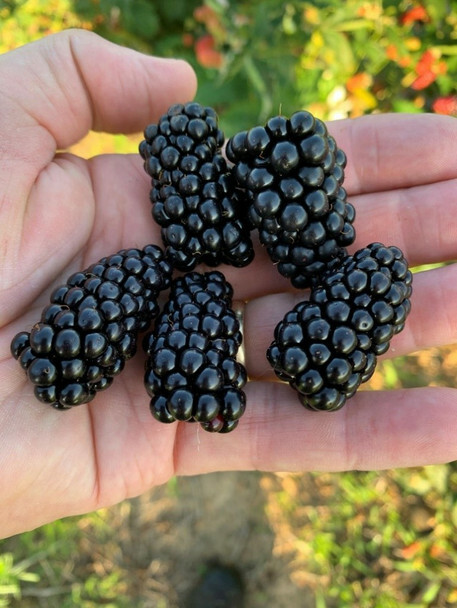
Most gardeners do not leave blackberries on the vine long enough for them to fully develop. When harvested too early, the berries are sour. Ripe fruits lose their shiny color and turn a dull black.
As with raspberries, fruit should be picked in the morning on a sunny day for better quality and higher sugar content.


Depicting how blackberries give new lateral growth where the leaves are cut
Harvest
Most gardeners don't leave blackberries on the vine long enough to develop properly. When harvested too early the berries are sour. Ripe fruits lose their shiny color and start to turn a dull black. As with raspberries, fruit should be picked on a morning in a sunny day for better quality and more sugar content.